
What a Jewellery Content Creation Tool Should Deliver Today
A modern jewellery content creation tool has a single mission: compress weeks of traditional photography, retouching, and coordination into hours—without compromising on studio-quality results. Whether launching a capsule collection or refreshing evergreen product pages, brands need versatile outputs: clean packshots on true white for marketplaces, stylized lifestyle campaigns for social, and on-model imagery that communicates scale and emotion. The best platforms unify these outcomes in one intuitive workspace so teams can go from concept to launch quickly, consistently, and at a fraction of legacy costs.
Speed and consistency are only valuable if photorealism is unquestionable. Fine jewellery demands accurate representation of metal finishes, prong geometry, pavé set patterns, and the way gem facets catch micro highlights. A serious tool understands the physics of light on gold, silver, platinum, and rhodium plating, resolves diamond fire and dispersion, and preserves micro-detail in milgrain and engraving. It should also support brand look-and-feel with reusable lighting rigs, camera presets, and scene kits so every ring, bangle, or pendant can slot into an established visual language across PDP, email, and print without constant manual tweaks.
For creators moving from idea to sellable image, the platform must ingest more than photos. It should accept sketches, moodboards, and CAD files, then produce render-accurate interpretations that mirror intended dimensions and materials. Smart editing shortens the gap from raw asset to perfect export: nondestructive color correction, specular cleanup, dust and fingerprint removal, and realistic reflection controls. Multichannel-ready outputs—2K for social, 4K for hero placements—eliminate the need for reshoots or costly upscaling. When paired with a drag‑and‑drop studio, even small teams can curate full seasonal narratives without a physical set.
Crucially, the right system hardwires e-commerce needs: perfectly centered packshots, consistent scale across variants, metal and gemstone swaps for instant assortment expansion, and compliance-safe backgrounds. It should master batching so ten stone colors or three metal finishes render in minutes, not days. Teams looking to modernize production can evaluate a dedicated Jewellery content creation tool that brings AI-powered realism, template automation, and collaborative workflows together, turning fragmented tasks into a single, repeatable pipeline that scales with demand.
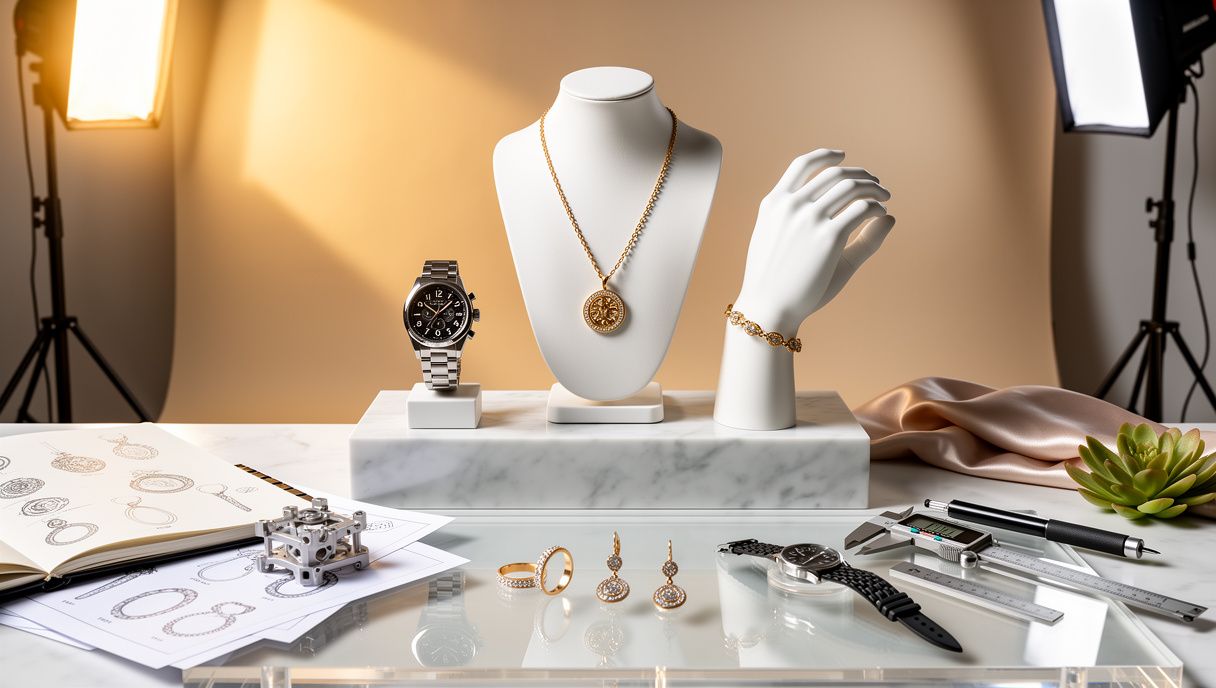
End-to-End Workflow: From CAD and Bench to Launch-Ready Visuals
Everything starts with the source asset. When uploading a CAD file, the platform should auto-detect materials and map them to an advanced library for 14K/18K gold alloys, platinum, sterling silver, and rhodium finishes. Gemstones need physically accurate indices and dispersion settings to represent diamond, moissanite, sapphire, emerald, and colored semi-precious stones. This is where a robust render engine matters: sub-surface scattering on pearls, anisotropy on brushed metal, and micro-roughness on hammered textures are not optional details—they’re what make design intent legible on screen.
Lighting and camera decisions define brand personality as much as the product. A refined jewellery content creation tool offers reusable light rigs, from high-key setups for catalogue work to moody lifestyle scenes that produce elegant reflections without clipping highlights. On-mandate shots—top-down ring stacks, 45-degree beauty angles, macro detail views for prong work—can be templated. Scene presets handle reflective bases like marble or lacquered wood, while synthetic “model” hands, necks, and ears enable on-model imagery without a live set. Designers can test stones under warm, cool, or mixed lighting to pre-qualify ad creatives before spend.
Finishing is where efficiency meets polish. Smart editing tools handle metal toning, specular control, gemstone sparkle balance, and dust cleanup in a nondestructive layer stack. Batch operations push consistent adjustments to a full collection, so every solitaire and eternity band meets the same spec: white balance, exposure, and scale. Export profiles automate e-commerce and marketing needs—square 1:1 for marketplaces, 4:5 for social, widescreen for homepage banners—plus high-fidelity 2K for feeds and 4K for print or hero slots. Color accuracy options spanning sRGB, Display P3, and CMYK-proofed outputs help align digital-first visuals with catalogues and lookbooks.
Finally, collaboration and version control keep teams moving. Creative directors approve lighting and angle templates; merchandisers request gemstone swaps; growth marketers A/B test background palettes for CPC efficiency. Integration with PIM, DAM, or storefronts allows automated renaming, metadata tagging, and direct asset sync to PDPs. The net effect is a continuous pipeline: CAD to fully merchandised galleries, packshots to stylized lifestyle campaigns, and seasonal refreshes rolled out in hours rather than weeks, all inside one consistent, audit-friendly workspace.
Real-World Scenarios: Artisans, Boutiques, and Scaling Luxury Houses
Consider an independent artisan preparing a bridal drop. Traditionally, prototypes would ship to a studio, followed by a full day of photography, retouching, and reshoots for missing angles. Using an AI-powered jewellery content creation tool, the same artisan imports CADs, chooses signature softbox lighting, and generates hero angles, halo close-ups, and hand-on shots via synthetic models. With batch metal changes—yellow, white, rose—and a swap for center stone shapes, the collection expands from eight SKUs to dozens of merchandising images. Launch assets for PDP, Instagram, and print-ready hero banners are produced in 2K and 4K, saving budget for influencer placements and paid search.
A boutique brand managing omnichannel distribution needs rigid consistency. Marketplaces demand true white backgrounds; the website requires a warmer narrative tone; retail partners ask for layered TIFFs. A robust platform lets them lock a “catalogue” lighting rig for compliance, then clone the scene into lifestyle variations with muted backdrops and organic textures for editorial storytelling. On-model scenes—earrings on earlobes, pendants on décolletage—maintain correct scale and sit naturally against skin-matched tones. Cross-team workflows mean the merchandiser requests gemstone alternatives in bulk, while the brand lead approves final colorways all inside a single dashboard.
Emerging DTC icons often need to sell the dream before the benchwork is complete. With concept-to-reality design, sketches evolve into photoreal test images ahead of sampling, allowing teams to field-test creative on social, validate price points, and forecast demand. Pre-orders go live with accurate renders, complete with micro details like milgrain borders and pavé sparkle, reducing the risk of overproducing slow movers. Performance marketers can A/B test backdrop hues or props—slate, travertine, silk—then shift spend to the winner the same day. Faster read cycles translate into smarter inventory, stronger ROAS, and a cadence of fresh storytelling that keeps audiences engaged.
Heritage houses and watch-adjacent ateliers benefit from archive consistency and precision. Decades-old lineages can be re-shot virtually, unifying disparate photography into a single aesthetic standard without risking fragile pieces in transit. Complex materials—meteorite dials, guilloché patterns, ceramic bezels—receive authentic surface treatments, while macro-friendly cameras showcase craftsmanship at a level that static catalogues rarely achieve. For global campaigns, localization becomes trivial: one scene, many languages and aspect ratios, all versioned and approved through a governance-friendly workflow. This reliability empowers creative teams to move quickly without sacrificing the gravitas expected of high-luxury brands.
Across these scenarios, the capabilities that stand out are the same: realistic materials for metals and stones, reusable lighting systems, batch variant generation, on-model imagery without physical shoots, and seamless exports tailored to every channel. By consolidating steps that once lived across separate studios, agencies, and freelancers, a unified platform gives artisans, boutiques, and luxury houses the leverage to scale content output while protecting brand identity, margin, and speed to market.

Gdańsk shipwright turned Reykjavík energy analyst. Marek writes on hydrogen ferries, Icelandic sagas, and ergonomic standing-desk hacks. He repairs violins from ship-timber scraps and cooks pierogi with fermented shark garnish (adventurous guests only).