
Finding a dependable electrician in Bedford is essential for keeping homes comfortable, businesses efficient and public spaces safe. From consumer unit upgrades and rewiring to LED lighting, EV chargers, solar panels and battery storage, a skilled local specialist ensures every circuit is designed, installed and tested to today’s standards. Whether caring for a Victorian terrace near the Embankment, a new-build in Wixams or a warehouse on Elms Farm Industrial Estate, a knowledgeable professional delivers practical solutions that balance safety, performance and energy savings. For homeowners, landlords, facility managers and site supervisors, working with an experienced Bedford electrician streamlines compliance, reduces downtime and unlocks long-term value. To explore services from design to maintenance with a trusted local team, visit Electrician in Bedford.
Domestic Electrical Services in Bedford: Safety, Upgrades and Energy Efficiency
Modern homes depend on electrical systems that are both robust and adaptable. In Bedford’s mix of period properties and contemporary developments, the first priority is usually safety. Upgrading an older fuse box to a modern consumer unit with RCBOs and SPD protection supports the latest requirements in BS 7671 (18th Edition, Amendment 2), helping to guard against electric shock, overloads and transient voltage surges. Where properties are extended or renovated, partial or full rewiring replaces fatigued cable, corrects borrowed neutrals or aging junction boxes and restores confidence that circuits match today’s loading and protection needs. For landlords across Bedford, Kempston and Biddenham, timely EICR inspections every five years (or at tenancy change) remain vital for legal compliance and tenant safety.
Energy efficiency is equally crucial. Swapping dated fittings for quality LED lighting cuts consumption dramatically while improving colour rendering and ambience in kitchens, living rooms and home offices. Smart controls—dimmers, sensors and schedules—further refine usage without sacrificing comfort. In spaces like loft conversions in Putnoe or garden rooms in Bromham, careful design avoids nuisance tripping and delivers lighting layers that suit both task and relaxation. Where outdoor areas need attention, IP-rated garden and security lighting increases safety around paths, garages and driveways while remaining understated and reliable.
Transport and renewable upgrades are transforming Bedford’s homes. Professionally installed EV charge points sized for the property’s supply and likely charging patterns bring convenience and cost control, especially when matched with off-peak tariffs. Solar PV with battery storage helps households generate, store and use their own clean electricity, reducing grid reliance and cushioning against rising tariffs. A knowledgeable installer will handle grid notifications (G98/G99), advise on inverter placement, ventilation and cabling routes, and integrate batteries to prioritise self-consumption, backup or time-of-use optimisation. With thoughtful system design, solar and storage can power daytime loads, evening routines and even EV charging.
Real-world example: A 1930s semi in the De Parys area underwent a consumer unit upgrade, ring final circuit remediation and LED retrofit. The homeowner then added a 5 kW solar array with a 10 kWh battery. After commissioning and handover, the property’s evening grid demand dropped by over 60% in spring and summer months. The owner now charges a plug-in hybrid overnight on a low-rate tariff and offsets daytime household usage with stored solar—an approach that pairs safety, sustainability and practical savings in a single plan.
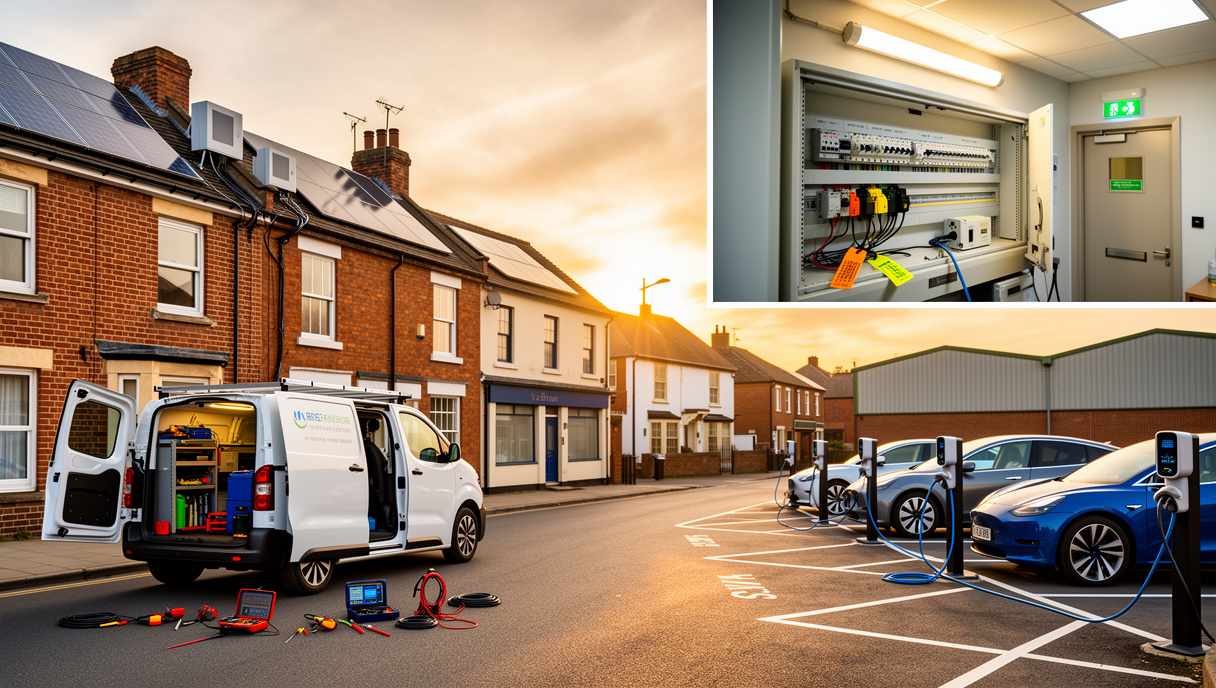
Commercial and Industrial Expertise Across Bedfordshire
Local businesses—from high-street retailers in Bedford town centre to logistics hubs around Elms Farm Industrial Estate—benefit from electrical systems tailored to their operations. In offices at Priory Business Park, balanced three-phase distribution, resilient data-friendly power and quality LED panels reduce eye strain and drive productivity. For hospitality venues along the Embankment, ambient lighting, emergency lighting to BS 5266 and discreet power routing elevate guest experience without compromising safety. Schools, clinics and community facilities require dependable installations with clearly labelled distribution, tamper-resistant accessories and scheduled inspection routines that fit around term times or public opening hours.
Warehouses and factories across Cardington, Wootton and Stewartby often pursue upgrades that boost efficiency and reliability. LED high-bay retrofits with occupancy and daylight sensors cut energy usage and heat output while improving light uniformity on picking aisles and production lines. Power factor correction smooths demands on the supply, potentially reducing kVA charges. Thermal imaging surveys pinpoint overheating terminations on MCCs and busbars, allowing proactive maintenance before breakdowns. Where machinery moves or expands, reconfigured containment, additional sockets and new final circuits keep layouts agile without sacrificing compliance.
Compliance and documentation underpin every project. Commercial EICRs are typically scheduled every five years (or more frequently for certain industrial environments), ensuring protective devices, earthing and bonding remain effective. Portable appliance testing, while risk-based, is integrated into sensible maintenance cycles for shops, offices and hospitality sites. Emergency lighting testing and logbook management assure safe evacuation routes. For premises with higher risk profiles—HMOs, care settings or student accommodation—recommendations such as AFDDs on socket circuits are evaluated case-by-case under the latest standards to enhance protection where it matters most.
Case in point: An Elms Farm distribution centre commissioned a full LED upgrade, replacing sodium fittings and adding controls zoned by activity. The project reduced lighting energy by more than half and improved lux levels for scan accuracy. Concurrent distribution board maintenance uncovered a deteriorating main switch isolator, replaced out-of-hours to avoid disruption. The site later installed eight workplace EV chargers using load management, enabling fleet electrification without an immediate supply upgrade—evidence that practical engineering and phased investment can align with operational growth.
Compliance, Testing and Fast Fault-Finding for Peace of Mind
Electrical compliance is not a checkbox; it is an ongoing process that keeps people safe and assets protected. In Bedford’s housing stock—terraces off Castle Road, apartments near the riverside and new estates in Great Denham—the right testing strategy reduces risk and surprises. Periodic inspection (EICR) assesses wear and tear, protective device performance and critical items like RCDs. RCD testing and verification ensure rapid disconnection on fault currents, while surge protection addresses transient overvoltage events that could otherwise damage electronics. For many rented homes, a five-year EICR cycle is standard; for owner-occupied properties, a 10-year interval (or at sale/change of occupancy) is common guidance. Commercial cycles vary with environment, but robust records and clear remedial plans are universal essentials.
When faults arise, targeted diagnostics save time and cost. Skilled electricians use continuity, insulation resistance and earth fault loop impedance testing, along with selective component isolation, to locate issues methodically. Nuisance tripping on ring finals is frequently linked to cumulative earth leakage from multiple appliances, shared neutrals or undersized cable extensions. Thermal imaging reveals hotspots invisible to the eye, while power quality analysis can expose harmonics or sags that upset sensitive equipment. Effective fault-finding pairs instruments with experience—recognising patterns in installations from Kempston bungalows to light-industrial units around Manton Lane.
Emergency lighting and life-safety systems demand special attention. Testing to BS 5266 ensures escape routes are properly illuminated once the mains fails, with monthly function checks and annual duration tests recorded in a logbook. Where sites also operate fire alarms to BS 5839, coordinated maintenance avoids conflicting schedules and ensures standby power is adequate. Clear labelling, accessible isolation points and tidy containment contribute to safer interventions when the unexpected happens—especially critical in schools, healthcare and assembly spaces where evacuation efficiency matters.
Example from experience: A Kempston office reported intermittent RCD trips disrupting a small server room. Inspection identified a legacy ring with mixed wiring methods, high leakage peripherals and an overloaded extension chain. The remedy combined circuit segregation, RCBO protection, new dedicated radial circuits for ICT loads, and a small UPS installation with surge protection. The outcome was immediate stability and a documented pathway for future expansion. Similar, structured responses apply across Bedford—whether restoring supply after storm damage in Bromham, preparing a landlord property for a new EICR in Brickhill, or commissioning a solar-and-battery upgrade in Shortstown—demonstrating how prompt testing and precise fixes deliver lasting peace of mind.

Gdańsk shipwright turned Reykjavík energy analyst. Marek writes on hydrogen ferries, Icelandic sagas, and ergonomic standing-desk hacks. He repairs violins from ship-timber scraps and cooks pierogi with fermented shark garnish (adventurous guests only).